
Suzetrigine and Headache: A Promising New Direction
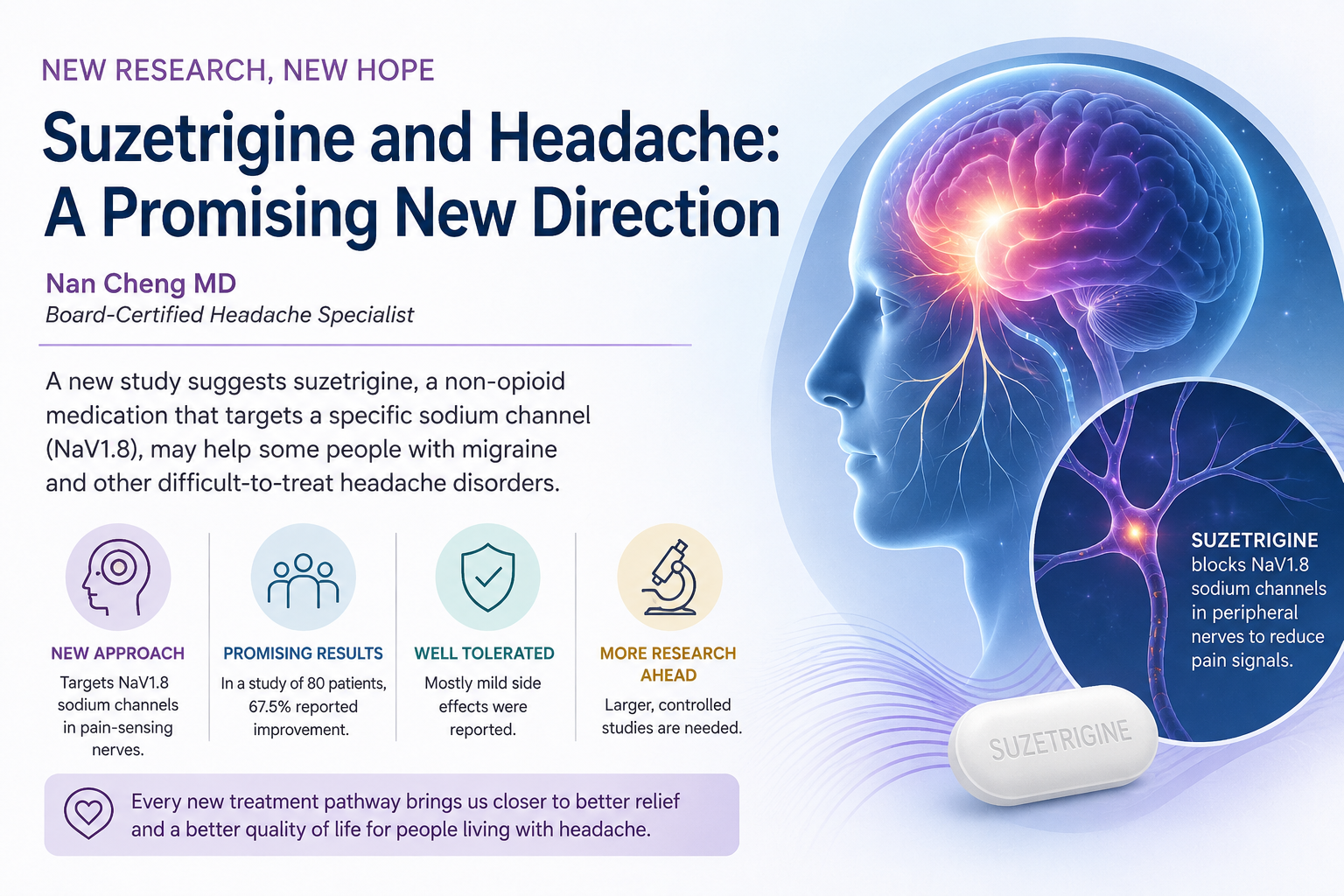
At the latest American Headache Society Scientific Meeting, I had the opportunity to moderate a session highlighting new developments in headache medicine. One study that especially caught my attention explored suzetrigine for migraine, headache, and facial pain disorders.
The findings are still early, but they offer a hopeful look at a completely new way of treating pain, particularly for people who have not responded to existing therapies.
What is suzetrigine?
Suzetrigine is a non-opioid pain medication that blocks a sodium channel called NaV1.8. This channel is found mainly in peripheral sensory nerves that transmit pain signals.
Its mechanism is different from triptans, CGRP medications, and opioids. This is exciting because patients who do not respond to one treatment pathway may still benefit from a medication that works in a different way.
Can suzetrigine help migraine and headache?
Researchers reviewed 80 patients who received suzetrigine for headache or facial pain at an academic headache center.
Most had already tried multiple standard treatments without enough benefit or had experienced side effects that limited their options. The group included patients with chronic migraine, medication-overuse headache, trigeminal autonomic cephalalgias, neuralgia, facial pain, and other headache disorders.
Overall:
67.5% reported improvement
26.3% reported no change
6.3% reported worsening
Some patients reported mild improvement, while others experienced substantial relief.
Was suzetrigine well tolerated?
Suzetrigine was generally well tolerated in this study. Fifteen patients reported mild side effects, including itching, lightheadedness, and constipation. No serious adverse events were reported.
Is suzetrigine FDA approved for migraine?
Suzetrigine is FDA approved for the treatment of moderate to severe acute pain. It is not currently FDA approved specifically for migraine or other headache disorders. Using suzetrigine for headache would therefore be considered off-label. It is also not yet clear whether suzetrigine would work best as an acute treatment, a preventive treatment, or a short-term bridge therapy.
Why is this study encouraging?
Many of the most important advances in migraine treatment over the past several years have involved the CGRP pathway. These treatments have transformed headache care, but they do not work for everyone.
Suzetrigine targets pain through a different pathway. That may eventually provide another option for patients with difficult-to-treat migraine, headache, or facial pain. For patients who have already tried many treatments, the possibility of a new therapeutic target matters.
What are the limitations?
This was a small retrospective case series, not a randomized clinical trial. There was no placebo group, the patients had different diagnoses, and many were receiving other treatments at the same time. The study therefore cannot prove that suzetrigine caused the improvement.
Larger, controlled studies are needed to determine which headache disorders are most likely to respond, the best dose and treatment duration, whether suzetrigine should be used acutely or preventively, and its long-term safety.
The bottom line
Suzetrigine is not yet a standard treatment for migraine or other headache disorders, but these early findings give us a genuine reason to be hopeful.
Its unique mechanism may open the door to a new category of headache treatments. For people who have struggled to find relief, every new treatment pathway represents another opportunity. Suzetrigine is an important one to watch.
To learn more about available migraine and headache treatment options, contact us to schedule a consultation with a headache specialist.
This article is for educational purposes only and is not a substitute for individualized medical advice.
Reference
Fensterwald M, Johnson J, Moreno A, et al. Suzetrigine as a novel treatment for headache disorders: A case series. Headache. 2026. doi:10.1111/head.70147.