

Peripheral Nerve Blocks
Targeted Relief and Prevention
Peripheral nerve blocks are a versatile tool in advanced headache medicine. Whether used to interrupt an acute, debilitating flare-up or as a scheduled prevention strategy, these precision injections offer a targeted way to desensitize the overactive pain pathways associated with chronic headache disorders.

A Dual-Action Approach
At Irvine Headache Care, we utilize nerve blocks for two primary purposes:
The "Cycle Breaker" (Acute Relief): For patients in the midst of a "status" migraine or a severe cluster cycle, a nerve block can provide rapid relief and "reset" the nervous system.
The "Prevention Bridge" (Proactive Care): For many patients, nerve blocks are used as a scheduled preventative strategy every 4–12 weeks. This proactive approach helps maintain a lower baseline of pain, reduces the frequency of attacks, and can be a vital alternative for those who prefer to avoid daily oral medications or who are waiting for other preventatives to take effect.
The Specialist Difference
As a UCNS-certified headache specialist, Dr. Cheng performs these procedures with a deep understanding of cranial anatomy.
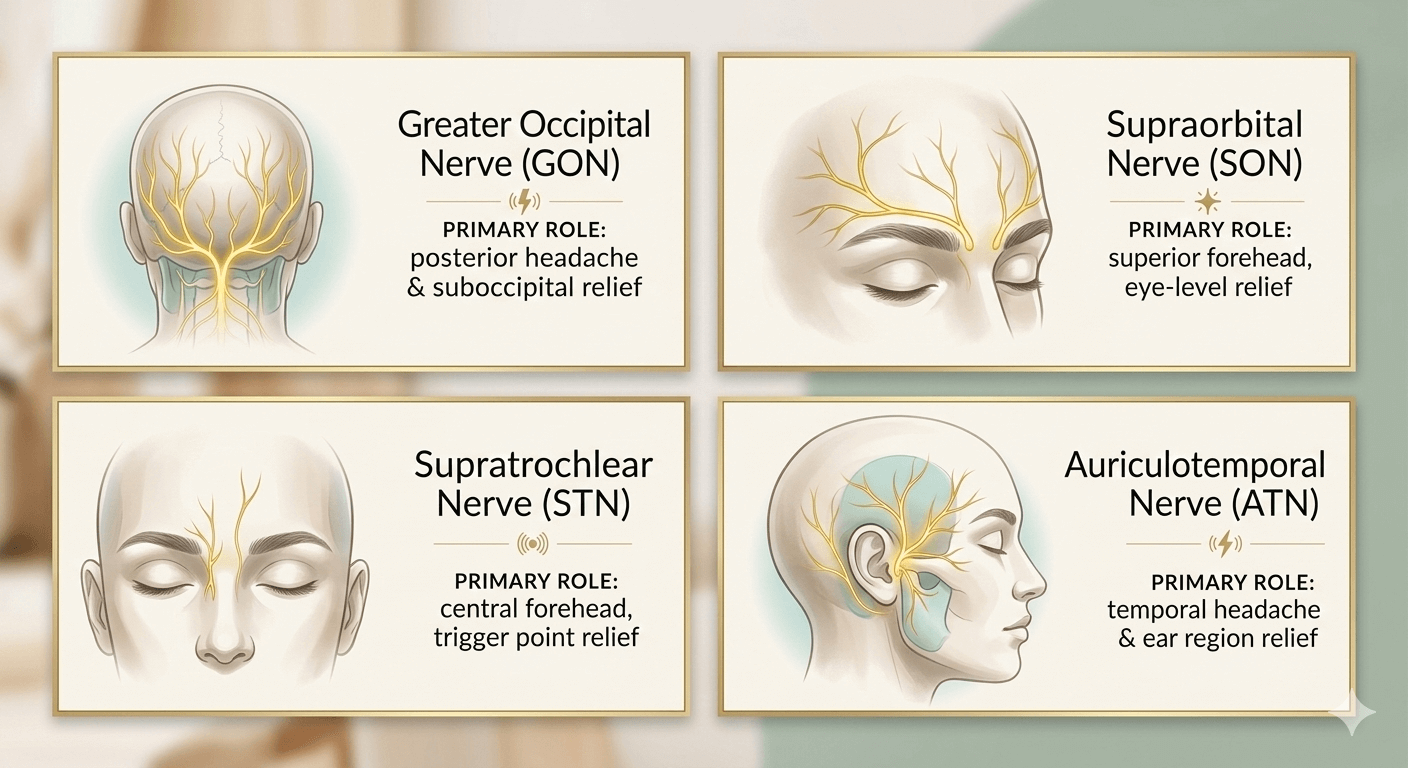
Specialized Expertise: Precise targeting of the occipital, supraorbital, supratrochlear, and auriculotemporal nerves.
Tailored Medications: While many blocks are performed with local anesthetics to minimize side effects, steroids may be indicated and added for certain patients, particularly those experiencing intense inflammatory cycles or refractory cluster headaches, to provide more prolonged relief.
Personalized Frequency: We tailor your treatment schedule, whether it’s a one-time "rescue" or a monthly preventative plan, based on your specific headache pattern.
What to expect?
We prioritize your comfort and use the finest needles available to ensure the process is as gentle as possible.
The Sensation: As the local anesthetic is administered, it is normal to feel a brief, warm sensation, often described as a mild stinging or burning that lasts only a few seconds. This is a positive sign that the medication is reaching the nerve and beginning its work to "quiet" the pain signaling.
The "Numbing" Effect: The stinging is quickly replaced by a localized numbness. This sensation confirms that the block has been precisely placed, and many patients find this "quieting" of the nerve to be an immediate relief.
No Downtime: The entire process takes only a few minutes. Because we do not use systemic sedation, you can drive yourself home and resume your day immediately after your visit.
A Note on Navigating Insurance Obstacles
Over the past several years, many traditional insurance carriers have increasingly denied or restricted coverage for peripheral nerve blocks, often labeling these vital treatments as "not medically necessary" or requiring lengthy, bureaucratic appeal processes.
At Irvine Headache Care, we believe your relief shouldn't be held hostage by an insurance adjuster's paperwork. By choosing our direct-pay model:
No Denials: You and Dr. Cheng decide on your treatment plan, not a third-party payer.
No Hidden Costs: You will never receive a surprise bill months later because a claim was "retroactively denied."
Transparent Pricing: You know the exact, flat fee for your procedure before you even walk through our door.
Focus on Care, Not Paperwork: We spend our time treating your pain, not fighting insurance companies for permission to help you.
Frequently Asked Questions about Nerve Blocks
-
While both are injections, they work differently. Botox® is a long-term preventative that takes several weeks (or months) to build up in your system. A nerve block uses local anesthetic to provide immediate "numbing" relief and can be used as a "rescue" to break a severe flare-up or as a monthly strategy to lower your overall pain baseline.
-
One of the primary benefits of a specialist-led evaluation is that we don't have to take a "one-size-fits-all" approach.
Targeted (A La Carte): If your pain is strictly localized (for example, only at the base of your skull or only behind one eye) we can perform a single, targeted block of the Occipital or Supraorbital nerve.
Combined Approach: For many patients, migraine pain is diffuse or involves multiple "trigger" zones. In these cases, we can combine all blocks during the same visit to provide more comprehensive coverage.
During your consultation, we will map out your specific pain patterns to determine which combination will provide you with the most significant relief.
-
We use the finest needles available to ensure the procedure is as gentle as possible. You will feel a quick pinch, followed by a brief stinging or burning sensation as the medication is administered. This is a normal sign that the anesthetic is reaching the nerve. The area will then become numb, often providing a sense of immediate "quiet" to the pain.
-
No. Many of our blocks are performed using only a local anesthetic to minimize systemic side effects. However, for patients experiencing intense inflammatory cycles or refractory cluster headaches, steroids may be clinically indicatedand added to provide more prolonged relief. Dr. Cheng will discuss the best combination for your specific headache type.
-
The "numb" sensation from the local anesthetic lasts for several hours. However, the goal of the block is to "reset" the overactive pain nerves. For many patients, this can break a headache cycle for several weeks or even months.
-
Yes. Unlike some procedures that require sedation, peripheral nerve blocks are performed while you are fully awake. There is no "downtime," and you can safely drive yourself home and resume your normal daily routine immediately.
-
In recent years, many insurance carriers have increased denials for nerve blocks, labeling them "not medically necessary" despite very strong clinical evidence and research studies. At Irvine Headache Care, we skip the administrative hassle of denials and appeals. We provide a flat, transparent price upfront, and we give you a detailed Superbill to submit to your PPO insurance for potential out-of-network reimbursement.